
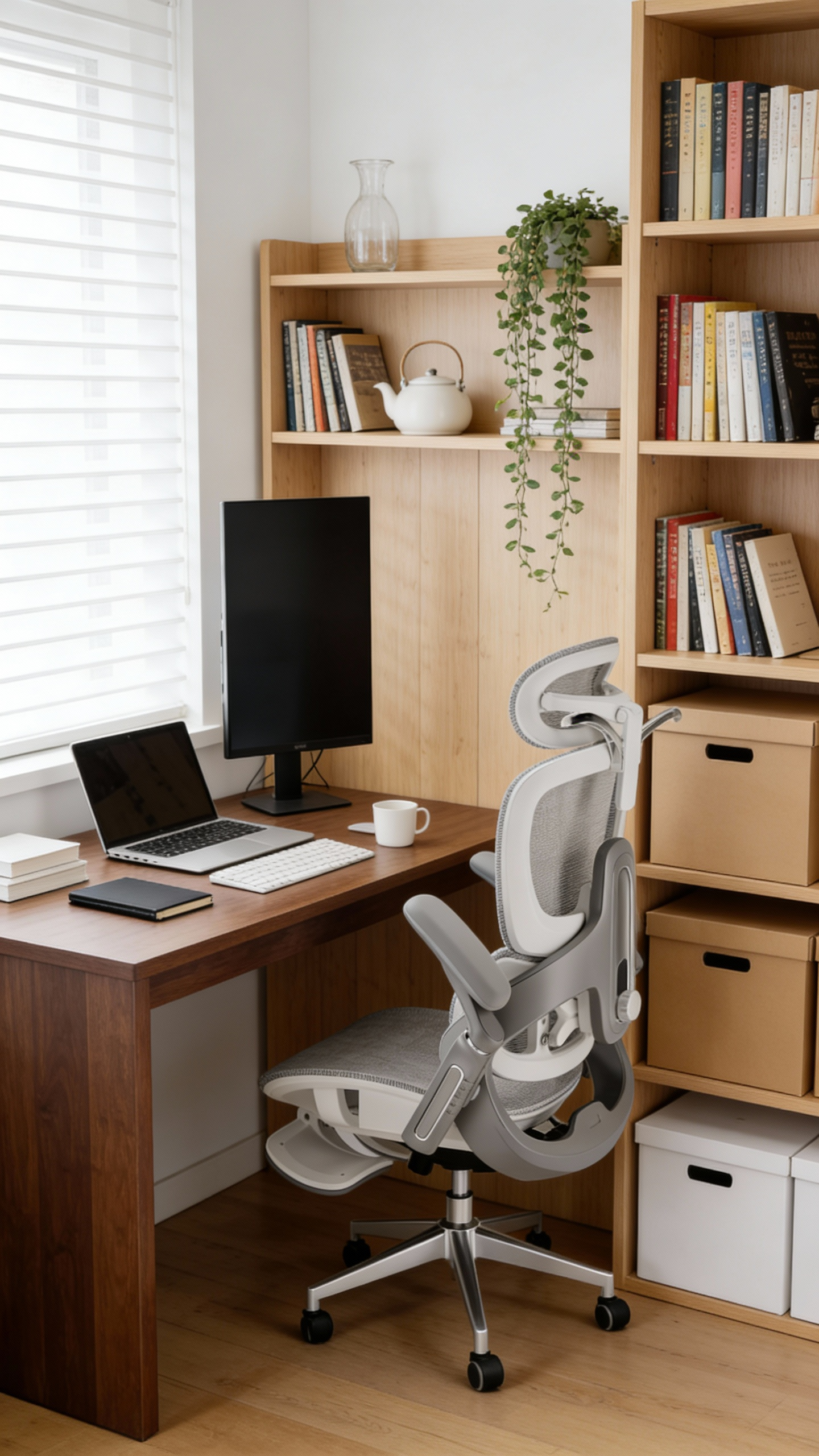
The Corner Setup Test: Choosing a Chair for a Bedroom-Sized Life
In a small room, an ergonomic chair can either solve your day or quietly ruin your layout. When your desk is forced against a wall, your chair has to live near the bed end, and the “extra space” you don’t have is exactly what most chairs assume. That’s the pain point: a chair can be perfectly ergonomic in theory, but useless in practice if it can’t park neatly, if it blocks your drawers, or if it turns every movement into a bump against the wall.
The most common small-room problem is not comfort—it’s geometry. A chair that looks fine online can be too deep once you include the backrest curve, so you can’t slide it in without the top of the back hitting the wall. A chair with wide armrests might prevent you from getting close enough to the desk, leaving you reaching forward all session. Some bases are so wide that they constantly catch the bed frame or your feet, and in tight corners you end up “driving” the chair like a shopping trolley just to sit down. Over time, the layout pressure creates posture problems: you perch at the edge to avoid hitting something, you sit diagonally, or you stop using the chair properly and return to the bed.
The solution is to buy for “parkability” first, then ergonomics—because in a tiny room, the chair must behave like a well-designed object when you’re not sitting in it. Start by thinking about your chair’s resting position. You want it to slide under the desk far enough that it clears your walking path. That typically means armrests that can drop low or move out of the way, and a seat that can tuck without the arm pads colliding with the tabletop. If your desk is narrow, look for armrests that don’t force your elbows outward—compact, inward-friendly shapes matter more than a thick, executive look.
Next, consider depth and wall clearance. If your setup is against a wall, a chair with a slimmer back profile can be easier to live with. More importantly, don’t buy based on “maximum recline angle” for a small room. Instead, choose a chair with a stable tilt that supports micro-changes in posture. In a corner layout, the ability to lean back slightly and return upright smoothly is more useful than a dramatic recline you can’t actually use without moving the whole chair.
Then handle the “bed-end squeeze.” If the chair sits near the bed, the base width and caster placement become critical. A compact wheelbase reduces snagging, and smooth casters help you roll in and out without shifting the bed or scraping furniture. If your floor is carpet, chairs that roll poorly will push you into awkward twisting—so stable movement becomes an ergonomic feature, not a convenience. Also check whether the chair looks visually heavy. In a small room, a bulky silhouette makes the corner feel tighter even before you sit down; a cleaner profile makes the space feel more breathable.
Kai, an international student in Canberra, lived in a share house with a bedroom that barely fit a bed and a desk. He needed one corner for lectures and late-night gaming, but his first chair couldn’t tuck in, so it blocked the wardrobe door. He replaced it with a compact chair whose armrests lowered under the desk and whose tilt supported small posture shifts without hitting the wall. Suddenly the corner worked: the chair parked neatly, the room felt navigable, and his shoulders stopped creeping up during long sessions.
Product connection: For small rooms, the best ergonomic chair is the one that passes the corner setup test. Look for tuck-in friendly armrests, a compact base, a slimmer back profile, and a controlled recline that works without extra clearance. Pair those layout-friendly traits with the essentials—adjustable seat height and practical lumbar support—and you get a chair that supports your body without demanding a bigger room to do it. In a tight space, the smartest chair is the one you can live around, not just sit on.
Share:
THE MESS YOU STOP NOTICING UNTIL IT DRIVES YOU CRAZY
WHEN YOUR DESK BECOMES A CABLE JUNGLE