
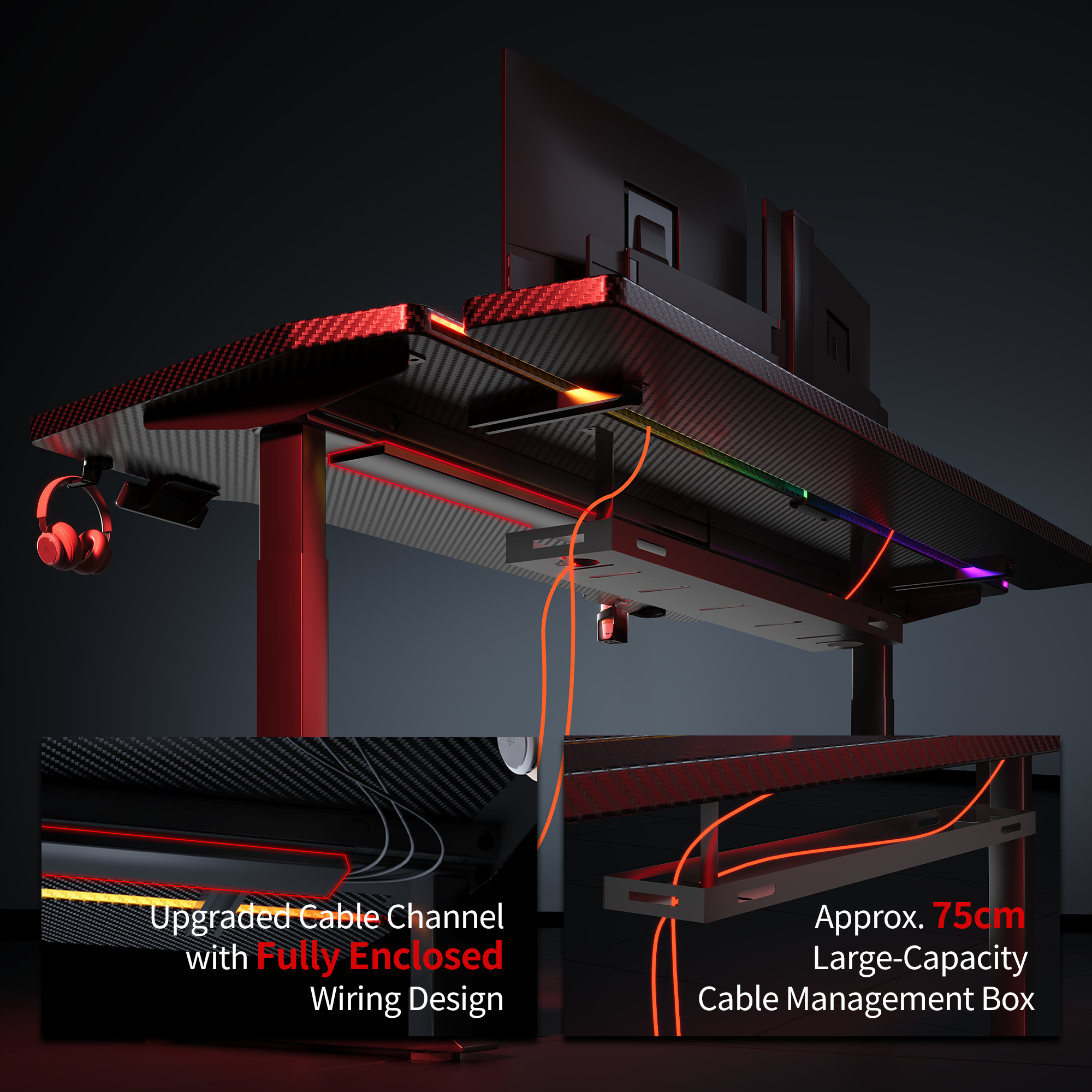
Scroll through almost any gaming desk listing in Australia and you’ll see the same promise: cable tray included, built-in grommets, integrated power, tidy setup guaranteed.
On paper, it sounds perfect. In reality, many buyers discover something different once the desk is assembled and all devices are plugged in.
When the Setup Gets Real
A modern Australian desk setup often includes:
- Dual monitors
- Monitor arms
- Desktop PC
- Laptop dock
- External speakers
- Charging cables (phone, headset, keyboard, mouse)
- A power board with bulky AU adapters
That’s when small design details start to matter.
Are the cable holes large enough for Australian plugs? Is the tray deep enough for a standard power board? Does the rear cut-out allow thicker laptop power bricks to pass through without force?
Many desks technically include cable features — but not necessarily ones designed around Australian plug dimensions and real-world use.
Why It Becomes Frustrating
The typical experience goes like this: everything looks clean before devices are connected. Then you try routing a thicker AU power adapter through a small grommet opening. It doesn’t fit. You end up lifting the desk again, rerouting cables, or attaching an external power board underneath.
Instead of a clean single-entry cable path, the setup turns into a mix of internal tray + external hanging cords.
The issue isn’t a lack of features. It’s a mismatch between marketing visuals and actual equipment size.
What Actually Works
- Rear cable openings sized for AU/NZ plugs
- A tray deep enough for full-size power boards
- Enough clearance for laptop charging bricks
- Durable cable channels rather than thin ties
Some desks treat cable management as decoration. Others design it as infrastructure.
The AGKey desks, for example, include a dedicated under-desk cable box rather than a shallow decorative net. This creates proper routing space for power boards and adapters without forcing cables into tight bends.
Whether using the height-adjustable K1 or K2, or the fixed S3 frame, the goal is the same: route once, don’t re-route every month.
A Perth Apartment Reality
A Perth apartment resident recently shared that his previous desk had cable holes that looked modern but were too small for standard Australian plug heads. He ended up threading cables before attaching plugs — something no one wants to do repeatedly.
When he switched to a setup with larger routing access and a proper cable box underneath, the difference wasn’t aesthetic — it was practical. He could change devices without dismantling the entire system.
Clean Setup Isn’t About Looks
In Australian homes where desks often sit in open-plan living areas, cable management isn’t just cosmetic. It affects airflow, cleaning, safety, and how often you’re willing to adjust your workspace.
A tidy desk isn’t created by marketing keywords. It’s created by realistic cable space.
Share:
Before You Clamp That Monitor Arm: What Your Desk Edge Is Really Handling
Why Some “Integrated Power” Desks Don’t Work Well in Australia